


How to Maximize Tax Deductions
for Charitable Giving
_________________________________________________
Last year, the federal government passed the One Big Beautiful Bill Act (OBBA), which locked in many of the tax changes that occurred in the previous tax bill: the Tax Cuts and Jobs Act (TCJA), which went into law in 2017. While on the surface, the OBBA locked in many of the rules and changes of the previous tax bill, there are some new changes that should be addressed as we approach the end of the year. Today, we will cover charitable giving.
Standard deduction vs. itemizing
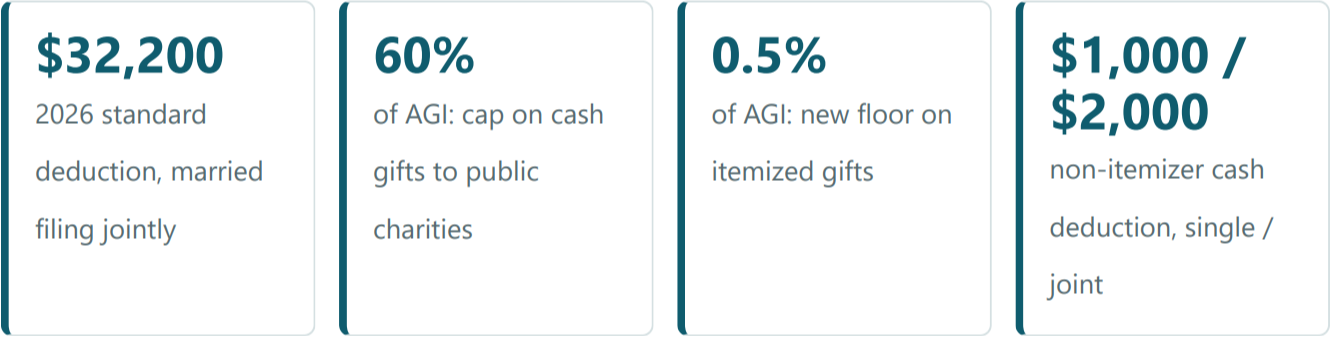
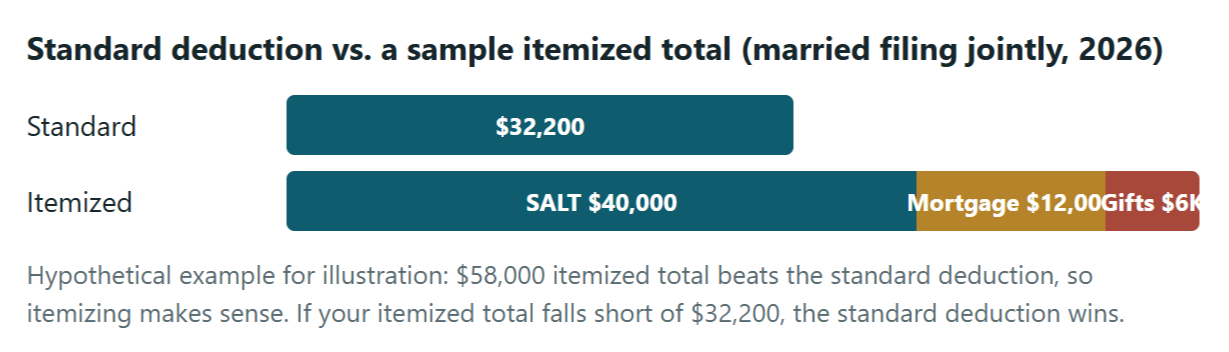
Charitable contributions are considered a below-the-line deduction. What does that mean? It means that these deductions compete against the standard deduction the federal government gives you when you complete your 1040. As an example: if you file “Married Filing Jointly” on your tax return for 2026, you will receive a standard deduction of $32,200 that is used to shield a portion of your income from taxes. You also have the choice to itemize your taxes, which allows you to use certain deductions if they exceed your standard deduction.
Some itemized deductions include:
- SALT Tax, which includes state and local taxes such as property taxes (the limit was increased to $40,000).
- Mortgage Interest (on up to $750,000 of qualified home debt).
- Medical Expenses (above 7.5% of your AGI).
- Charitable Contributions (which we will cover below).
The cap on large gifts
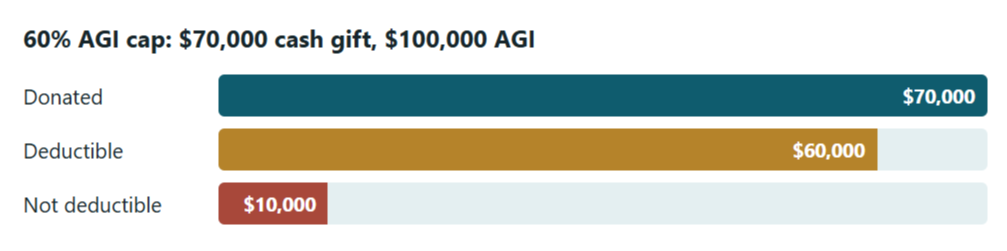
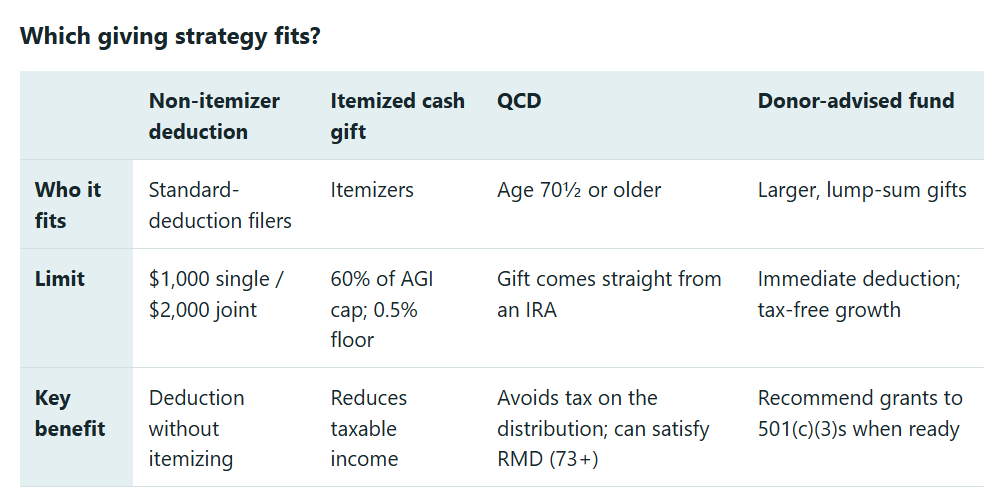
Donations to public charities have a cap. For instance, cash is limited to 60% of your adjusted gross income. (Adjusted gross income is your total income before you take the standard or itemized deduction.) So as an example, if your adjusted gross income was $100,000 and you decided to make a large cash donation of $70,000 to a recognized public charity, you would be limited to $60,000 (meaning $10,000 of your donation would not be credited as a deduction).
The new floor on smaller gifts
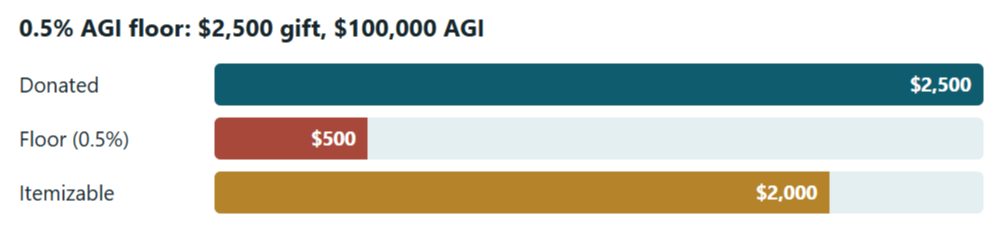
The OBBA has added a new feature that creates a floor to how much can be deducted on smaller contributions. The floor is now 0.5% of your AGI on contributions. This becomes more important for individuals who make smaller donations throughout the year.
Using our previous example, if a person who has AGI of $100,000 donates $2,500 to a charity, that $2,500 is reduced by the new 0.5% floor, which would only allow them to itemize $2,000 of charitable contributions.
For smaller charitable donations: the IRS now allows a new non-itemized charitable deduction through the OBBA. If you do not itemize your tax return and take the standard deduction, single filers can donate up to $1,000 in cash donations and joint filers may deduct $2,000 in cash donations.
Strategies for larger donations
If you are age 70½ or older, you can begin making Qualified Charitable Distributions (QCDs). QCDs allow an individual to give to a charity directly from their IRA and avoid taxes on the distribution.
If you are age 73 or older and need to take a required minimum distribution (RMD), QCDs can count toward part or all of your RMD. This can become important if you are trying to stay below certain income tax brackets.
Another strategy if you are looking to make a large donation is to consider a donor-advised fund (DAF). A DAF is a specialized charitable account that allows you to make an irrevocable contribution of cash or investments and take an immediate deduction. The assets are allowed to grow tax-free. Once you’re ready, you can recommend grants from those assets to the charities of your choice (as long as they are recognized 501(c)(3) organizations).
If you are leaving assets in your will to a charity, you may want to consider making these gifts during your life to help reduce your income taxes. Remember, when you die, you generally do not get to use these deductions in the same way you would while you’re living. Plus, as we like to say, it’s better to give with a warm hand than a cold one.
Interested in putting these strategies to work? Let us help. We can open donor-advised fund accounts with as little as $25,000, and we regularly help clients make qualified charitable distributions. Reach out soon so there is time to complete your gifts before the December 31 deadline.